
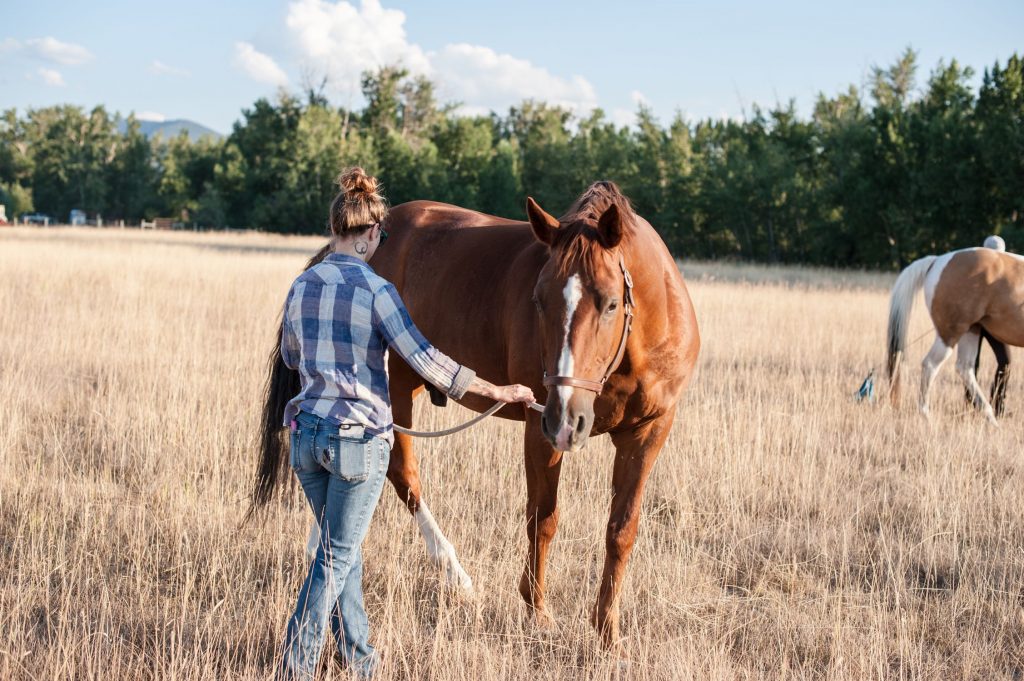
Groundwork Practices for Harmonious Motion
A Sequence of Foundational Movements
Many horses move stiff, unbalanced, and asymmetrical. These horses often travel with more weight on one shoulder, lean more easily in one direction, asymmetrical barrel movement, or allow one hind leg to step through more efficiently than the other. These tendencies affect balance, relaxation, and the ability to move with freedom and softness, especially on curved lines and during transitions. When horses are ridden without first addressing these natural asymmetries, tension accumulates and movement over time can compromise joint health. All factors that point to why it is important to study Equine Biomechanics.
Stretching and Relaxation Movements
Groundwork exercises help to soften the topline, poll, and ribcage. They invite the horse to lower their head, breathe deeply, and release the habitual tension patterns that prevent balance.
Lowering the head to the ground helps the horse relax the topline and shift into a parasympathetic state. Gentle poll flexions free the muscles connecting head, neck, and shoulder. Soft rubbing beneath the headstall supports relaxation around the occipital joint.
These movements are not simply mechanical. They are an offering. They say to the horse, “You can let go now. You are safe.”
Shoulder and Barrel Softening Work
Exercises like shoulder-in and turning in a tight circle help the horse mobilize the ribcage and open the shoulder girdle. These movements promote flexibility, stretch the neck and barrel, and help the horse find lateral balance.
Loin and Haunch Engagement
Movements such as disengaging the haunches and backing in a circle help the horse develop awareness of their hind limbs and prepare for weight carrying. They free the loin, promote stepping under, and reduce bracing patterns.
Lateral Suppleness and Balance
Lunging on a small circle helps assess natural asymmetry and with timely corrections invites the horse to find balance, correct bend, contact, and rhythm. Leg yields and half-pass teach the horse to move diagonally with coordination and softness. These movements build suppleness, balance, and strength.
Integrating Straightness
All lateral work ultimately supports straightness. Straightness is not rigid linearity. It is the ability for the horse’s hindquarters and forehand to follow the same path with even contact and equal carrying power. Many horses are naturally asymmetrical. Through these movements, the horse begins to reorganize themselves. And through guiding these movements, the horseperson begins to reorganize the horses’ inner world.